
My father joined the Royal Navy. I do not know the exact date. He reached 18 in September 1941. I still have his Admiralty issue hairbrush, stamped 1942. I know that he was at home for his brother’s burial in June 1942. However, that might have been on compassionate leave.
Following on the train of thought from the previous articles (1938 – A father’s dilemma, A father’s dilemma (2) and A father’s dilemma (3)) was the Navy a safer option than the other two services? As with all data from WW2, it very much depends on the way that the question is phrased.
The Royal Navy expanded from about 200,000 in 1939 to nearly 1 million in 1945. (The RAF was a similar size in 1945) The figures include shore-based roles. Deaths (including those missing) were 51,578. A casualty rate of approximately 10% appears to be valid. It lost over 330 ships of all sizes. I looked in detail at the sinkings of 10 large ships. (Three battleships, two battlecruisers and five large aircraft carriers.) Just over 6,000 sailors lost their lives on these ships (12% of the total). 6,700 survived, making the loss rate 47%. As such, it is the same as the aircrew casualty rate. (see A father’s dilemma (3)). Luck still plays a part. Only one man out of 1488 was lost when HMS Ark Royal sank, because it took over 14 hours to go down. Only three men out of 1418 were rescued from HMS Hood, because it suffered catastrophic damage and sank in three minutes.
Ships that sank in arctic waters suffered high casualty rates. Those that sank in warmer climes had a better chance of survival. HMS Hood sank between Greenland and Iceland. The water was described as ‘intensely cold’. It was probably just above freezing. This would give a survival time for a man in the water measured in minutes. The three survivors had all manged to clamber into life rafts.
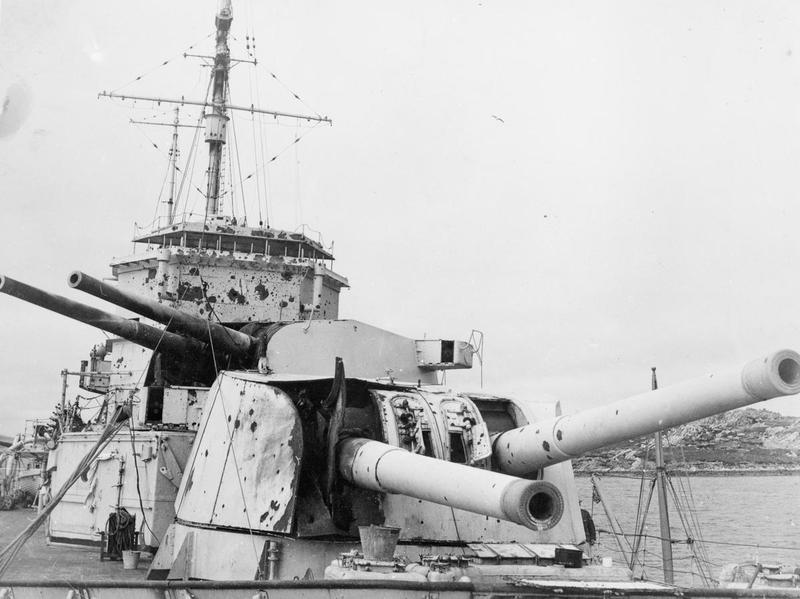
I also looked at the casualty rates for ships that had engaged in significant action but did not sink. HMS Exeter was the most badly damaged cruiser in the Battle of the River Plate in 1939. All four turrets of its main armament were put out of action. (pictured) Despite the severity of the damage, the death toll was relatively light. 61 men were killed and 23 wounded (Approximately 10%). Only 11 were killed on the other two cruisers (1%). The Battleship HMS Prince of Wales accompanied HMS Hood in the action against the Bismark. It was hit by 15” shells but only 13 men were killed.
It seems clear that serving on surface warships gave a good chance for survival. The situation was different for submarines. When a submarine was lost it was almost always with all hands. Often there was no definite information about its fate. Submarines that failed to return are often regarded as still being on patrol.
By accident or design, my father was exposed to lower risks than in either the Army or the RAF. Furthermore, he spent most of his time on HMS Tyne, a depot ship. This had a support role and was not expected to engage in major encounters with the enemy. (See VE Day: Patrick’s perspective) To the best of my knowledge, the ship suffered no casualties throughout the war. He survived. I owe my existence to that fact. Well done Patrick for his good advice.